


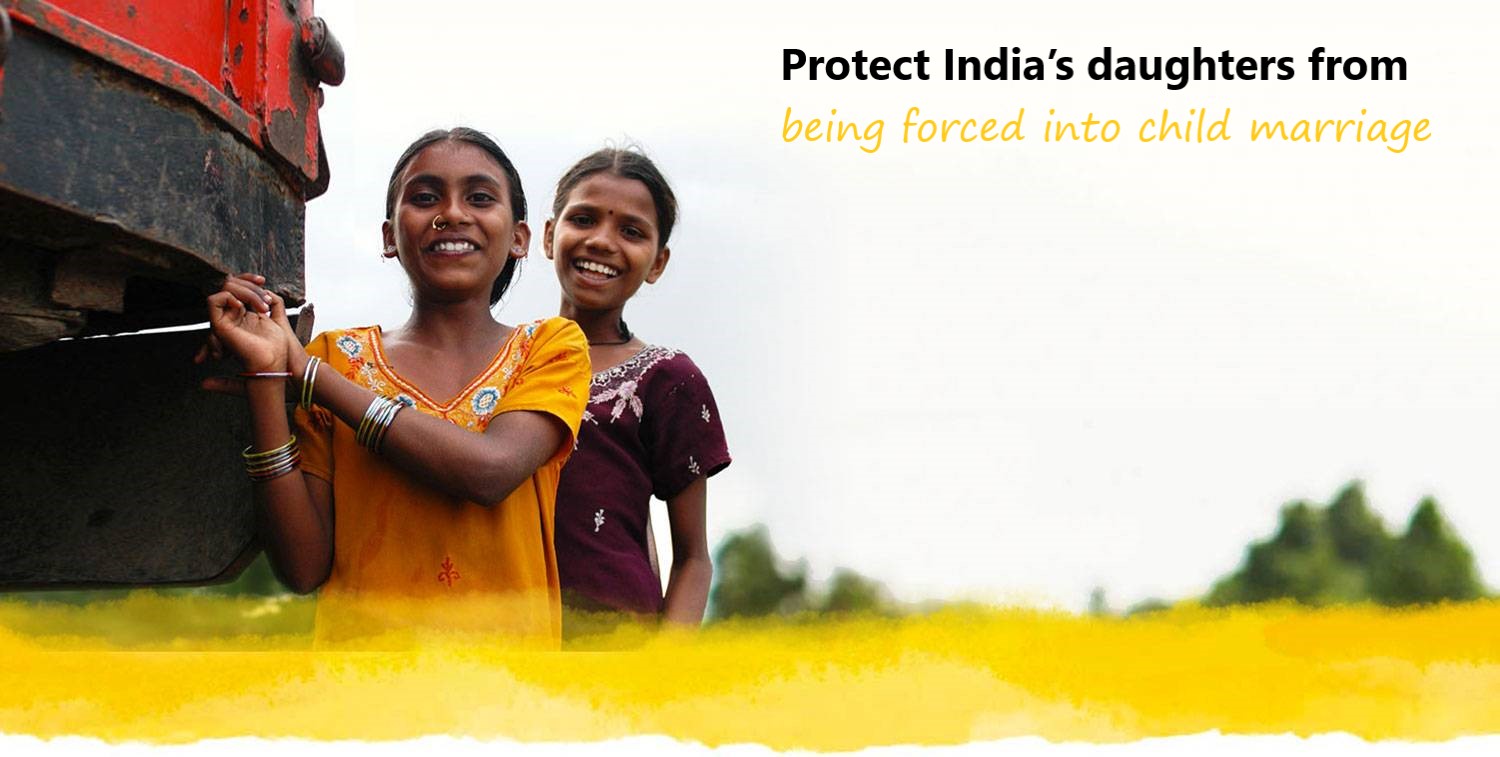
Stop Child Marriage
Child marriage is a crippling medical and social burden to women in India and poses a demographic threat to the entire world, health experts warned in The Lancet medical journal on Tuesday.
Specialists in public health from India and the US looked at data for 22,807 women aged 20-24, selected from a geographical and social cross-section of Indian society,who took part in a survey in 2005 and 2006.
A total of 44.5% of the women had been wed by the time they were 18, set as the legal age for marriage since 1978. Of these, 22.6% had been married before the age of 16 and 2.6% before the age of 13.
Women who had been child brides were 37% more likely not to have used contraception before their first child was born; seven times more likely to have three or more births; and three times more likely to have a repeat childbirth in less than 24 months.
They were also more than twice as likely to have multiple unwanted pregnancies, nearly 50% more likely to have an abortion and more than six times more likely to seek sterilization compared with counterparts who had married after the age of 18. Child brides were also at greater risk of a fistula—a tear in the genital tract—as well as pregnancy complications and death and sickness as a result of childbirth.
“Child marriage has serious consequences for national development, stunting education and vocational opportunities for a large sector of the population,” says the paper, led by Anita Raj, a doctor at Boston University School of Public Health in Massachusetts. “Furthermore, marriage at a very young age has grave health consequences for both the young women and their children.”
Marriage at such ages has enormous adverse implications, not just for women’s health and empowerment in general, but also for humankind in the long term.
How This Young Girl’s Fight Against Child Marriage Inspired Other Girls In Her Village
Manisha Govind Ghorpade (Chandetepli, Jalna) studies in standard 12th. From 1st to 8th standard, she completed her education in the Zilla Parishad school in her village Chandetepli, and after that, she went on to study ninth and tenth in the Rajur School, Bhokardan, Jalna. Now, she’s pursuing Bachelor of Arts in the Vinayak University in Rajur. Her mother Kamlabai and her younger brother stay at home with her. Her elder brothers stay in Aurangabad.
Standing Against Child Marriage And Changing Mindsets
Coming from a fairly typical family, Manisha has a small house in Chandetepli village in Ghorpade, Jalna. Since her family doesn’t own land, they work as agricultural laborers in others’ farms. Manisha also helps her mother with household chores at home. Her story, though, is inspiring for other teenagers her age. When she was in the 8th standard, her family decided to get her ‘married off’. When Manisha got to know about this news, it was beyond her understanding. “I’ve not even completed my education, how am I supposed to get married?”, this thought baffled her to no end. Even before the prospective boy’s side came home, she declared. “I am not going to get married yet” and refused her own child marriage. This declaration of hers today has proved to be her affirmation for a positive future.
Getting Inspired By The Kishori Prerika Programme
Most families in rural Maharashtra make ends meet by working as agricultural labourers and doing whatever odd jobs that come their way. Manisha, too, comes from a family like this. Several families migrate from Chandetepli village to sugarcane fields for the job of cutting sugarcane for six months. At such times, parents want to get their daughters married to reduce their ‘burden’ of taking care of them.

Standing against her own child marriage wasn’t a one-day decision for Manisha. When asked about the tradition of child marriage, and where she got the courage to say no to it, Manisha responds, “There are two Anganwadis in my village. They’re run by Vandana Tai (Ghorpade) and Swati Tai (Ghorpade). Three years ago, when I was in the 8th standard, they used to conduct meetings for teenage girls in the Anganwadi. In these meetings, there used to be a ‘Conversation Box’ where girls could speak up. Additionally, Anganwadi Sevikas used to converse about menstrual health and hygiene with us. They used to give in-depth information about why child marriage is wrong. Besides, they also used to discuss how this is a crime according to the law. We’d hence, been introduced to these questions a long time back. That’s how we got inspired by the local Anganwadis.”
Consequences Of Saying No To Child Marriage
Child marriage is a crime, according to the law. Even if parents, relatives and caste collectives are aware of the law, they purposefully ignore it and view girls as just a responsibility that needs to be taken care of. When Manisha’s family started looking for prospective matches for her, a proposal came to them. When her family was deciding on her behalf, Manisha didn’t want any of this. She’d got a flood of information from the Anganwadi about why child marriage was wrong. Hence, she sat down and discussed why she didn’t want to marry yet with her mother and brothers.
“I want to study and not marry at all,” she told them. She also informed the Anganwadi tais. She didn’t stop at this. She warned her family that child marriage is a crime, and we will all have to face dire consequences for encouraging it. And then, it was decided, ‘let’s not get Manisha married’, ‘let’s continue her education’. Because of this dialogue, her strength and determination, Manisha can pursue University-level education today. The proposals kept coming though.
After getting to know of the ill-effects of child marriage, Manisha’s mother and brother were convinced by it. “I’m not going to get my child married off at such a vulnerable age,” her mother resolved and promised to encourage her education. After that, the marriage proposals kept coming in for Manisha, but her family refused them, then and there. Her confrontation about her marriage was a one-time mountain of disagreement with her family that Manisha determinedly navigated through. But it set a precedent for her family. She’s an inspiration for rural girls.
The Girl Who Said ‘No’, Continues To Fight
Manisha was aware of the ill-effects of saying no to child marriage. The awareness sessions for teenage girls held in the Anganwadi helped her a lot. “Which issues did you face when you said no to child marriage?”, “How did you deal with them?” When asked these questions, Manisha says, “Along with me, the girls in my class were also aware of child marriage as an issue because the Anganwadi Tai had spoken about it in very easy words. The video clips helped. Ever since then, I’d resolved never to let this happen to me.
In school, girls used to discuss this with each other. After I’d stood against my own child marriage, I came to know that two other girls, much younger to me, were about to get married too. I discussed why one is supposed to say no with them. I even went to their house and talked to their mother. Then, their parents finally decided to refuse the proposal.” This is how Manisha not only stopped her marriage but also encouraged other girls to stand up for themselves.
Refusing Regressive Attitudes And Behaviors, And Affirming Change
The fact that girls like Manisha, who come from rural Maharashtra, have the grit and determination to stand up for education, health, hygiene, nutrition and changes during puberty is evident. With Central government’s ‘Beti Bachao, Beti Padhao’ campaign in full swing for educating girls, there is a certain level of public awareness now, which is eroding the hold of regressive attitudes and behaviours. Girls are now able to assert their right to education, play and leading independent lives.

When asked about their inspiration, Anganwadi Workers, Vandana Ghorpade and Swati Ghorpade share, “Child marriage is exploitative, there’s no doubt about that. To stop it, girls are given support and knowledge. We train girls to talk about this topic in their communities too. When you’re the head of the Child Protection Committee in your village, you have some responsibilities, like resolving conflicts involving children, or training and sensitizing girls on how to stop child marriage. When we get a letter in the Conversation Box in our Anganwadi saying that someone has received a proposal for marriage, we assemble the girls for a meeting.
In such adverse realities, what would she like to do in her future, we asked. Manisha shares, “Children should have the freedom to pursue whatever good work they want to pursue or have the opportunity to pursue. I’m studying now, and soon, I’d like to work for the poor and marginalized communities. Other girls should also receive similar opportunities, and I want to ensure that.” Her mother, Kamlabai Ghorpade quips, “We need to enable girls to stand up on their own two feet. When she said she wants to learn, we encouraged her to do so.” To curb the deep-rooted issue of child marriage, a movement against poverty, against regressive attitudes and for educating girls is underway, and girls like Manisha are leading it!
Only when women are empowered,we may build a world, that is worthwhile to live in.The cause to empower women must not fade under any circumstances and there should be persistent genuine efforts to achieve gender equality.We are offering assistance for "ALL PROJECTS" that serve the cause of women empowerment.
Why Donate?
Did you know that 1 in every 3 child brides in the world is from India?
The issues of child marriage and early motherhood have come in the way of millions of underprivileged young girls and their dreams. With the loss of livelihoods during the on-going crisis, this situation will only worsen as more young girls are married off at an early age to ease the family’s financial burden.
HER is working tirelessly to address the issue by conducting online counselling sessions with adolescent girls, organizing home visits to high risk homes, building awareness on the ill-effects of child marriage among Panchayat leaders & VCPC members, tracking potential cases of impending child marriages and getting help from the police to stop them, connecting parents with MNREGA job opportunities and ensuring that girls are able to go back to school post the lockdown.
But we can’t do this without your support. Donate to HER, India’s most trusted NGO, to protect underprivileged girls from child marriage. No contribution is too small and will make a big difference by giving India’s daughters a chance at a brighter future in a COVID world.
This is the impact YOU helped us achieve in 2020-21

9,652
children in HER project areas, under the age of 1 year, immunized.

2,176
children in HER project areas, under the age of 5 years, free from malnutrition.

7,582
children in HER project areas rescued from child labour, child marriage and child trafficking".
